A Fine Diner Befitting Istanbul: Ristorant Di Italia Massimo Bottura
It is impossible not to be impressed by the Spice Bazaar
It is impossible not to be impressed by the Spice Bazaar
The intense smell of spices that start to tingle your nose before you step in the building; a few steps further, the miscellaneous herbs with names that you haven’t even heard of; the tulip patterns on the ceiling, greeting you with their elegance if you raise your head a bit; a rich variety of herbal teas, creams and plants that you’ll hear have the capacity to cure anything else than death, and the friendly shopkeepers who offer everyone a piece of lokum saying that it won’t make you fat at all…
Oscar Farinetti was right about that, it is impossible not to be impressed by the Spice Bazaar (tr. Mısır Çarşısı).
Having been inspired by the Spice Bazaar during a touristic tour in İstanbul in 1997, Oscar Farinetti created the Eataly concept. He brought together the Italian items, chefs and recipes under one umbrella and opened the first Eataly in Torino in 2007. Eataly is currently promoting the Italian culture in 30 different locations in the world, including the United States, Japan and Italy.
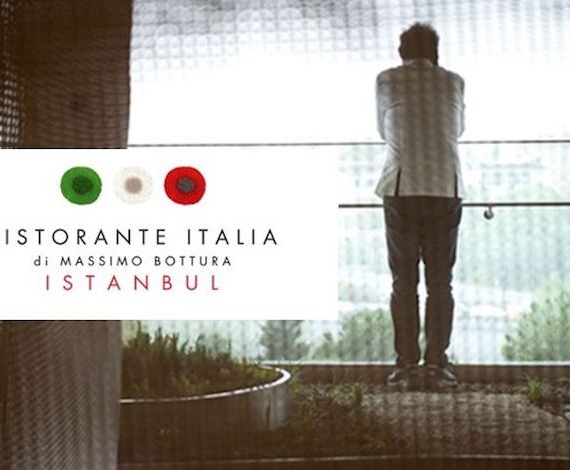
Opened in the last month of the last year, the Istanbul store of Eataly was, no doubt, a great news for the whole gourmet world. It has attracted such a huge public attention that Istanbul has become one of the top 10 culinary destinations in the world in just 6 months. Of course, it couldn’t, happen without the renowned chefs who exhibited their talents at Zorlu Center. Putting aside, in my opinion, the second class fine diners like Tom’s Kitchen, Jamie’s or Morini, the main reason that brought me to Eataly Istanbul was the restaurant opened by Osteria Francescana, the #3 chef of the world. It is “Ristorante Italia di Massimo”.
A Genuine Tradition: Massimo Bottura
There are three things sacred to the Italian:
The Pope, the national football team and la nona which means grandma in Italian.
Reworking the original recipes of the Italian cuisine, in other words, the grandma recipes with new techniques, Bottura’s first principle is to unveil the “real” Italian flavors in their most basic forms. As he bases all his recipes on the traditional recipes, Bottura also is one of those innovative chefs who observe them from a distance to unleash their creativity.
After working with the legendary chefs like Alain Ducasse and Ferran Adrià; Bottura opened Osteria Francescana in his hometown of Modena in 1993. The restaurant has been ranked “the Third Best Restaurant in the World” with its three stars. In addition, he also owns another restaurant, Franceschetta 58 which has been rather successful in its own class. With his persistence and highly-acclaimed recipes, the chef received the prestigious “White Guide Global Gastronomy Award” in a huge event organized in Stockholm.
Following my last visit to Osteria Francescana in March, I had to try Ristorante di Italia as soon as possible. That’s why I acted on this opportunity fast and found myself waiting for the astonishing flavors created by Bottura on the beautiful terrace of Eataly.
You can reach the restaurant through a special door from the outside or using the special elevator. When you step into the restaurant, you’re welcomed by a modest atmosphere similar to the one in Modena. Again, you’ll see Bottega chairs, beautiful paintings on the walls and even my favorite part of the design, the thin lamps on the terrace section. The distance between the tables is as it should be. You don’t have to lower your voice to a whisper while dining. There are slightly transparent space-dividers between the tables, which create a fine private space for the diners without causing an ugly and thoroughly blocked view.
Particularly designed for the cigar aficionados and those who love watching the bright lights of Gayrettepe, the terrace offers a fairly pleasant experience to the diners. Our table was on the terrace too.
Bottura reworked 100 classical Italian recipes to create the menu. His preparation process involves various locations ranging from the Northern Alps to the southern tip of Pantellieria. The chef believes in a future built on healthy foods. That’s why the menu spans a variety of healthy, light and basic, yet delectable recipes.
First the table was served a decorative basket of grissini as we were familiar from Modena. But this time, it was accompanied by a piece of mozzarella with anchovy. The fried & breaded cheese was fresh and successful as an amuse bouche.
Grilled octopus was a great choice to start with. It was served with artichoke, tomato confit and home-made ricotta, all placed on a bed of peas puree. The octopus was not grilled or sun-dried like in the Greek islands. It was first sealed and then cooked with “sous-vide” technique rather than cooked the Greek way which makes it a bit chewy. After a process of vacuuming the meat and cooking it in a constant low temperature for a long time, the texture of the octopus was rather soft.
My choice for the pasta was tagliatelle au ragu, the same dish I ate in Modena. I chose it for just comparison. It was again made with cubed meat instead of using minced meat. The meat was made from veal tail, veal tongue and veal cheek, and served with some sauce made from tomato, carrot and celery. Although its texture and presentation wasn’t as good as the one served in Modena, it was a fine dish because of the offal meat in its recipe.
Before the main course, apple sorbet was served in shot glasses. The bottom layer of the drink was made with green apple puree and juice and there was a bit of yoghurt on the top. Although it looks colorful with sugar-rimmed glass, it was actually a sorbet. Considering the sugar sprinkles, it could have been prepared with a different fruit combination.
Our main dish was veal tongue. Cooked with “sous-vide” technique for days, it was served with some mustard and a type of lettuce special to Yedikule. Mainly planted in Yedikule in the past, the body of the Yedikule lettuce doesn’t have a wide diameter like the regular lettuce types but rather it has a thin but fairly long body. Served on a bed made from parsley, it left a nice aftertaste on our palates.
As I actually think the meat should be chewable to enjoy, I can’t say that I like sous-vide technique since it makes the meat overly tender. Despite the tenderness of the meat and the fact the veal tongue in Modena was more successful, apparently the best dish of the night in Ristorante di Italia was the veal tongue.
The other main dish was roasted sea bass. Served with some potato puree and Shiitake mushroom, its all taste was in its juice locked inside the fish. But again, it didn’t taste like the Özbek sea bass.
When it was time for the desserts, the first visitor of the table was a grandma’s recipe: tiramisu. Although it was originally made with layers like lasagna, this extraordinary presentation of tiramisu with Mascarpone cheese, coffee cream, foam cake and espresso ice cream was liked by everyone at the table.
The hospitable chef Daniele is an experienced sommelier. Hence, the restaurant has a rich variety of Italian wines. But the Kalecik Karası wine he recommended to pair with the veal tongue and tagliatelle created a fine balance.
If we talk about the pricing, I can say it is a bit highly-priced for Turkey of the past. But considering the Istanbulites who nowadays fork out a great deal of money for the second class restaurants which claim to be a fine-diner, it is reasonably priced. The restaurant offers its customers a high-quality dinner in a great atmosphere for about 100 € per capita.
If you want me to compare it with my dining experience in Modena, I can say Ristorante di Italia was a notch below Osteria Francescana. On the other hand, it doesn’t claim to have such high-class offerings, so it is meaningless to compare these two restaurants. After all, I can say it was a great win for Istanbul.
The Flattering Results
As I mentioned at the beginning, Bottura owned only two restaurants before Istanbul. Both of them are located in the little town where he was born and raised, in other words, Modena. The fact that such an awarded chef who owns the #3 restaurant in the world decided to open his third restaurant in Istanbul is an honor for the city!
Of course, we’re not talking about the chefs who open just another headquarter of their restaurants in Istanbul after they become famous. The difference is that Bottura personally tends to his ship. The excitement of the chef who plans to stay in Istanbul for ten days a month is beyond commercial concerns; it’s actually about leaving his culinary legacy to Turkey.
After a conversation, Bottura, the maître d'hôtel Daniel and I agreed on a dinner in Gile for some time. The fact that Daniel started to learn to speak Turkish, the ultimate care taken by the staff, hiring Turkish people in addition to the Italian staff and witnessing all the effort invested in the restaurant proves that the success of the restaurant will be permanent.
So far, only the second-hand franchises have been opened in Turkey. Massimo Bottura’s venture in Istanbul could actually be a turning point. If more popular chefs like Bottura come to Turkey, this could trigger the change we’ve been missing so far.
I hope that Ristorante di Italia Massimo Bottura will carry the torch without lowering its quality and will be a permanent resident of the Turkish culinary scene, even taking it a step further to make a breakthrough for Turkey.
Bon appétit and enjoy the taste of life!
Ristorante Italia di Massimo Bottura
http://www.osteriafrancescana.it/ristoranteitalia/index_tr.html
EATALY Istanbul
Zorlu Center
Levazım Mahellesi Koru Sokak no.2, 34340
Besiktaş / İstanbul
+90 212 366 66 66
Share

Fauna, son dönem lezzet düşkünlerinin kadrajına sıklıkla takılan bir İtalyan. Böyle dediğime bakıp da aklınıza popüler ve ağdalı bir İtalyan restoranı getirmeyin. Zira şef İbrahim Tuna’nın derdi ünlenmek değil, üretmek…

İzmir'in klâsik sokak yemeklerinde başı çeken söğüş, yemek için zaman tanımayan tatlardan biri...